








In early childhood theatre, children have to remember lines, listen for cues, watch their classmates, control movement, handle nerves, and imagine how another person feels. This encourages them to use memory, language, body awareness, patience, emotion, and imagination simultaneously.
By doing all of this, children develop their cognitive, social, and emotional skills. If you present the whole thing as a play, especially to children in preschool or the first few grades of elementary school, you create a safe space for them to experience what otherwise might be too intense in everyday life.
Because younger children rely on visual cues more than older ones, having a solid background can make the learning process easier and more fun. When the world has color, shape, and interesting details, they can understand the story faster and even use their creativity to bring in some personal touches to the role they are playing.
A good theatrical backdrop gives children a world they can read with their eyes before they ever say a line. It helps them remember where they are, what the scene needs, and how the character might feel. The stage becomes a classroom when children learn by doing, and the backdrop helps the story feel real.
Memorizing Lines Helps Children Practice Memory and Recall
Memorizing lines gives young children a reason to practice reciting from memory in a way that feels lively instead of stiff, like it usually is in a classical school setting.
Children often remember better when words are attached to action. In preschool and school theatre, children can connect words to movement, music, facial expression, classmates, and a specific moment in the story, supporting new and reinforcing existing neural networks.
By memorizing lines and movements, children also learn what comes first, what comes next, and what cue tells them to speak. They begin to understand that a scene has order. A song has a pattern. A story has a beginning, middle, and end.
A theatrical backdrop can help children memorize their cues by providing an easy visual map. When the setting looks clear, young children can attach lines to places. They may remember that a greeting happens near the classroom board, a playful moment happens in the toy store, or a quiet speech happens in a bedroom.
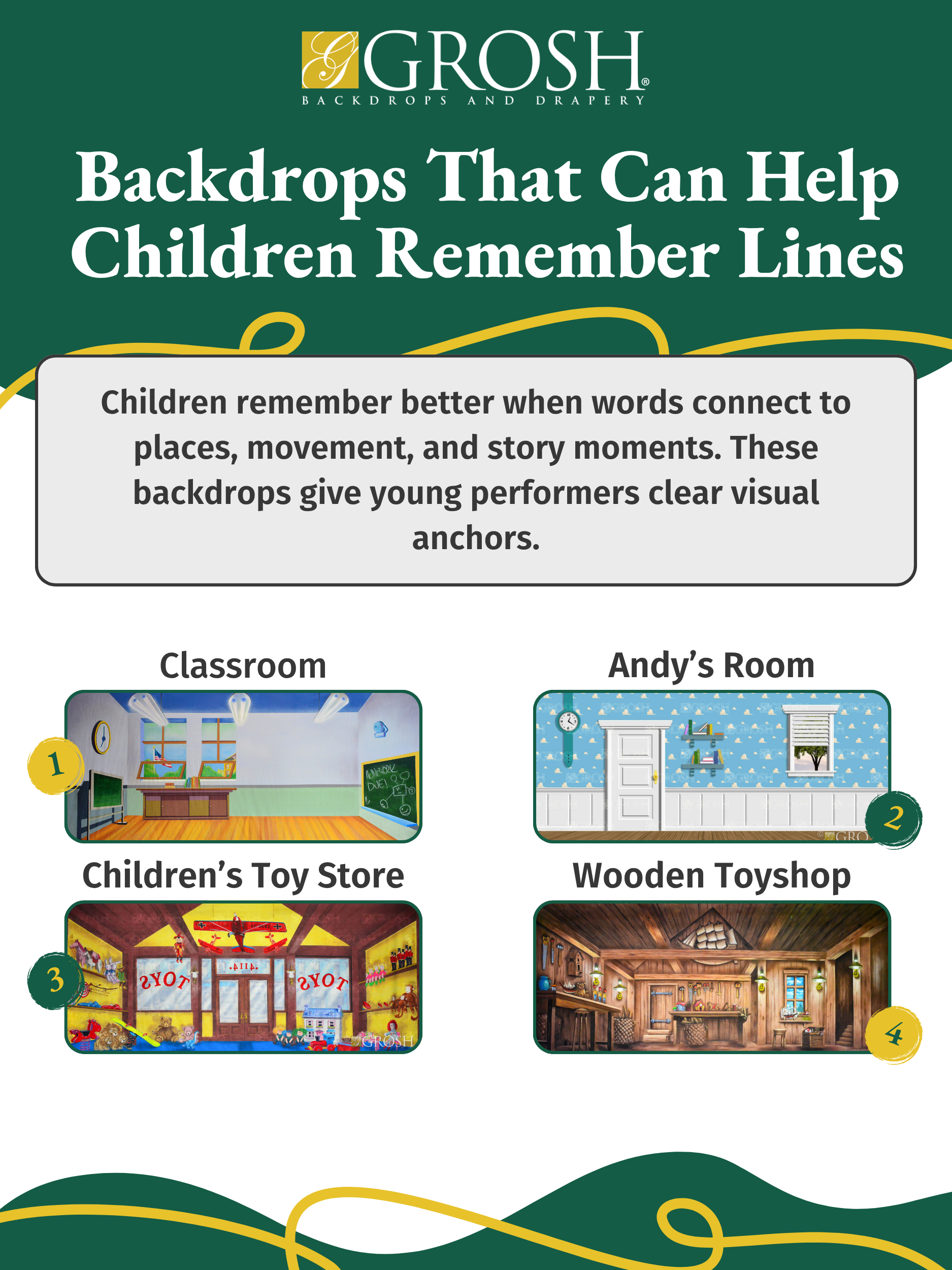
Classroom
A Classroom backdrop works well for early childhood theatre because the setting already lives inside a child’s daily life. Desks, windows, a chalkboard, school details, and the feeling of an ordinary learning space can help young performers relax into the scene.
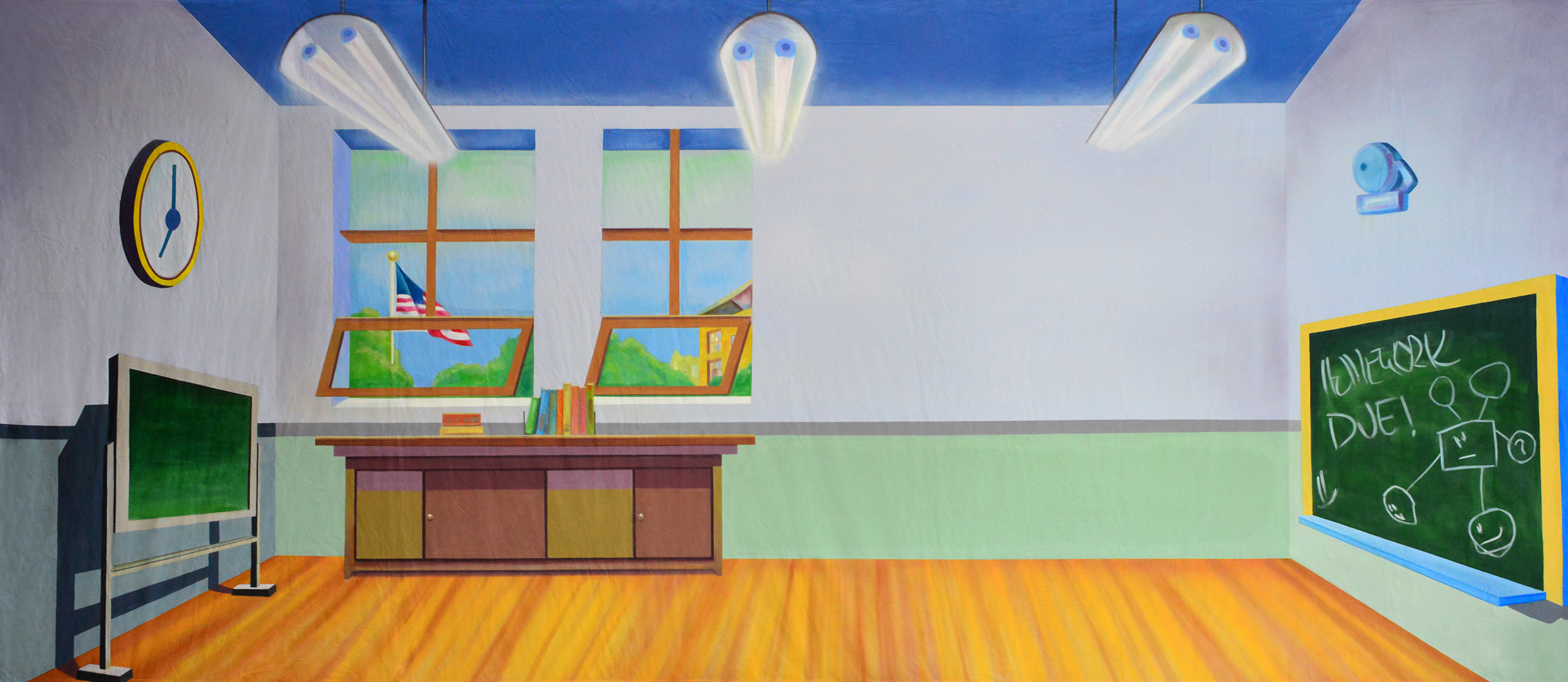
This kind of scenery also supports group scenes. Children can enter as classmates, line up for a class moment, gather around a pretend lesson, or practice speaking one at a time. They can see the room, understand the mood, and focus on listening for their next line.
Andy’s Room
Andy’s Room gives a school production a playful bedroom setting with a childlike sense of color and comfort. The blue sky, cloud wall design, and toy-friendly mood create a space where children can imagine stories about toys, growing up, or private little adventures.

A bedroom scene can help children remember lines because it feels personal. This backdrop can support productions where children play toys that come alive, siblings share a story, characters dream, or friends enter an imaginary world.

Children’s Toy Store
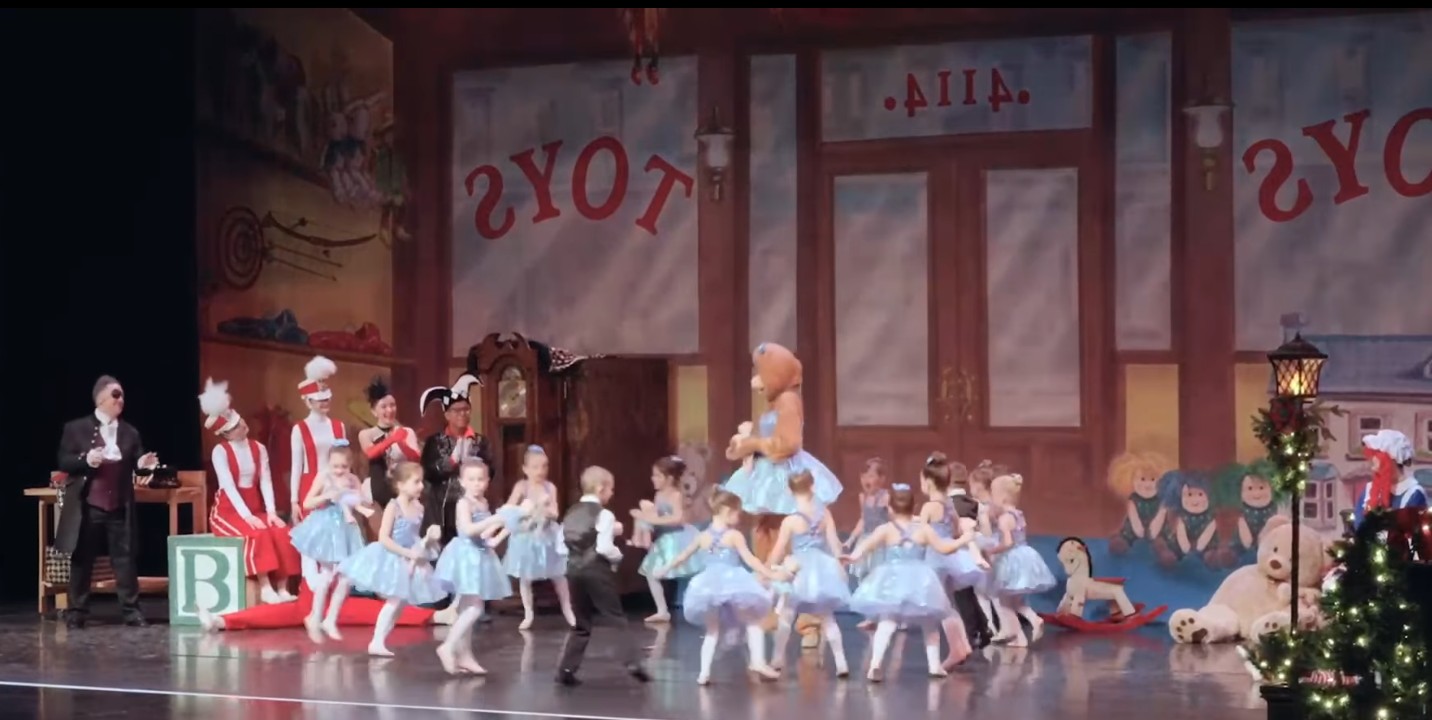
A Children’s Toy Store backdrop brings shelves, toys, warm colors, and a sense of wonder to the stage. This kind of scenery gives young children a lot to notice without making the setting confusing. It works for plays where toys come to life, or children explore a shop.
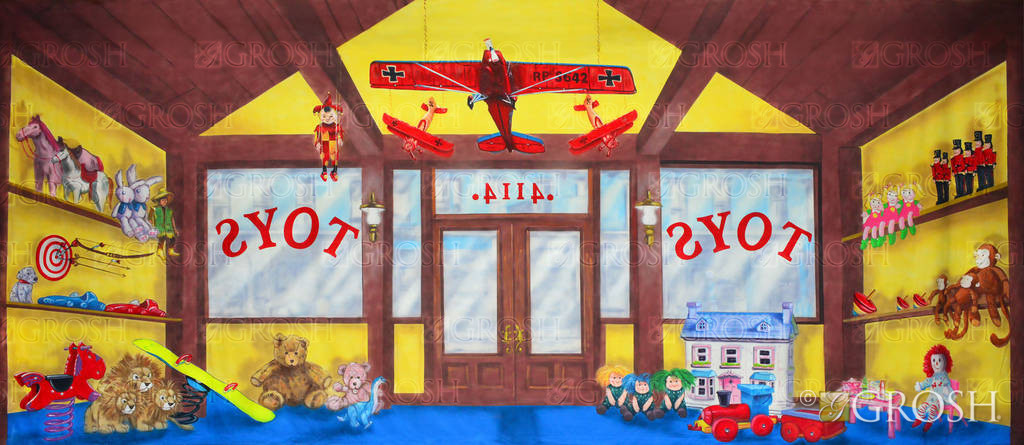
A teacher could use this backdrop for holiday performances, imagination-based plays, or simple scenes about sharing and responsibility. Since the setting has a strong sense of play, children can rehearse the same lines many times without the scene feeling flat.
Wooden Toyshop
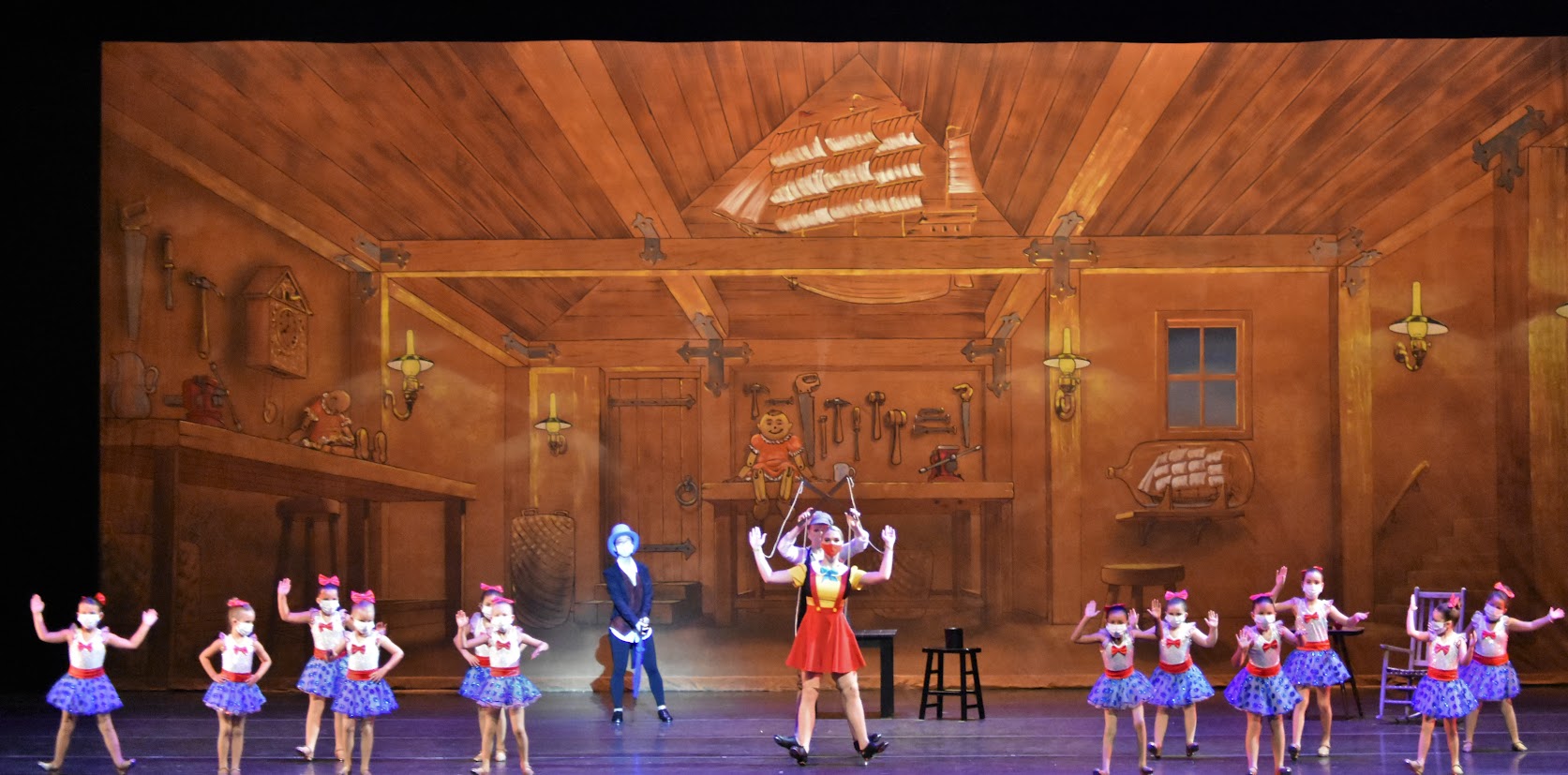
The Wooden Toyshop backdrop offers an older, handcrafted toy shop feeling. Workbenches, toy-making details, and classic toy imagery can help children step into a story about creation, patience, repair, or magical objects.
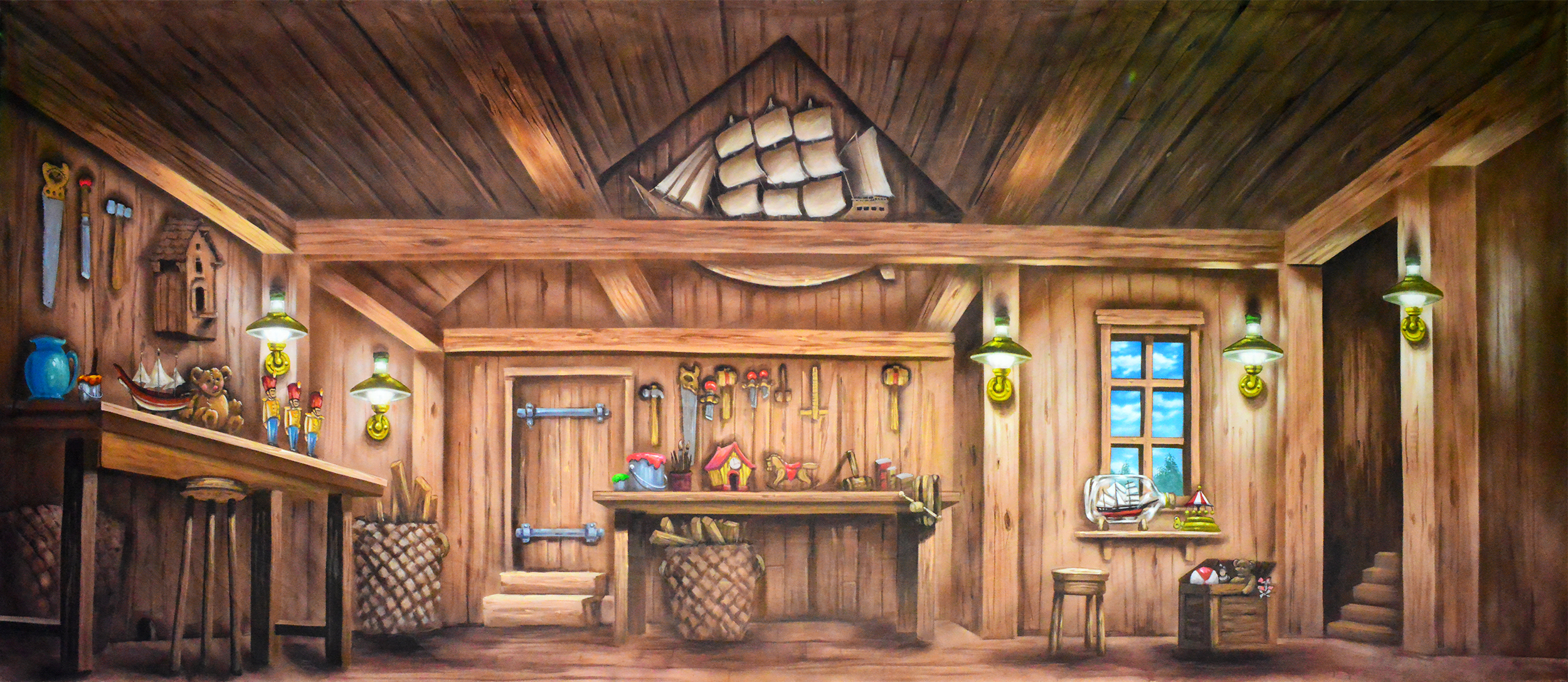
This kind of setting supports memory because it gives children a clear story logic. A toy shop has makers, helpers, toys, shelves, tools, and surprises.
Following Cues Builds Focus and Listening Skills
Children learn a lot from waiting. In the school or preschool theatre, waiting does not mean doing nothing. It means waiting for the cue that may come from a line, a gesture, a song lyric, a sound effect, or a teacher’s hand signal. Children need to follow what is going on around them at all times to do their part at the right moment.
This kind of waiting builds patience and focus and strengthens children’s attention, because it requires them to stay present and actively listen during the entire scene in which they perform.
Through this, children also begin to understand that communication does not only happen through direct instruction, which can build their adaptability.
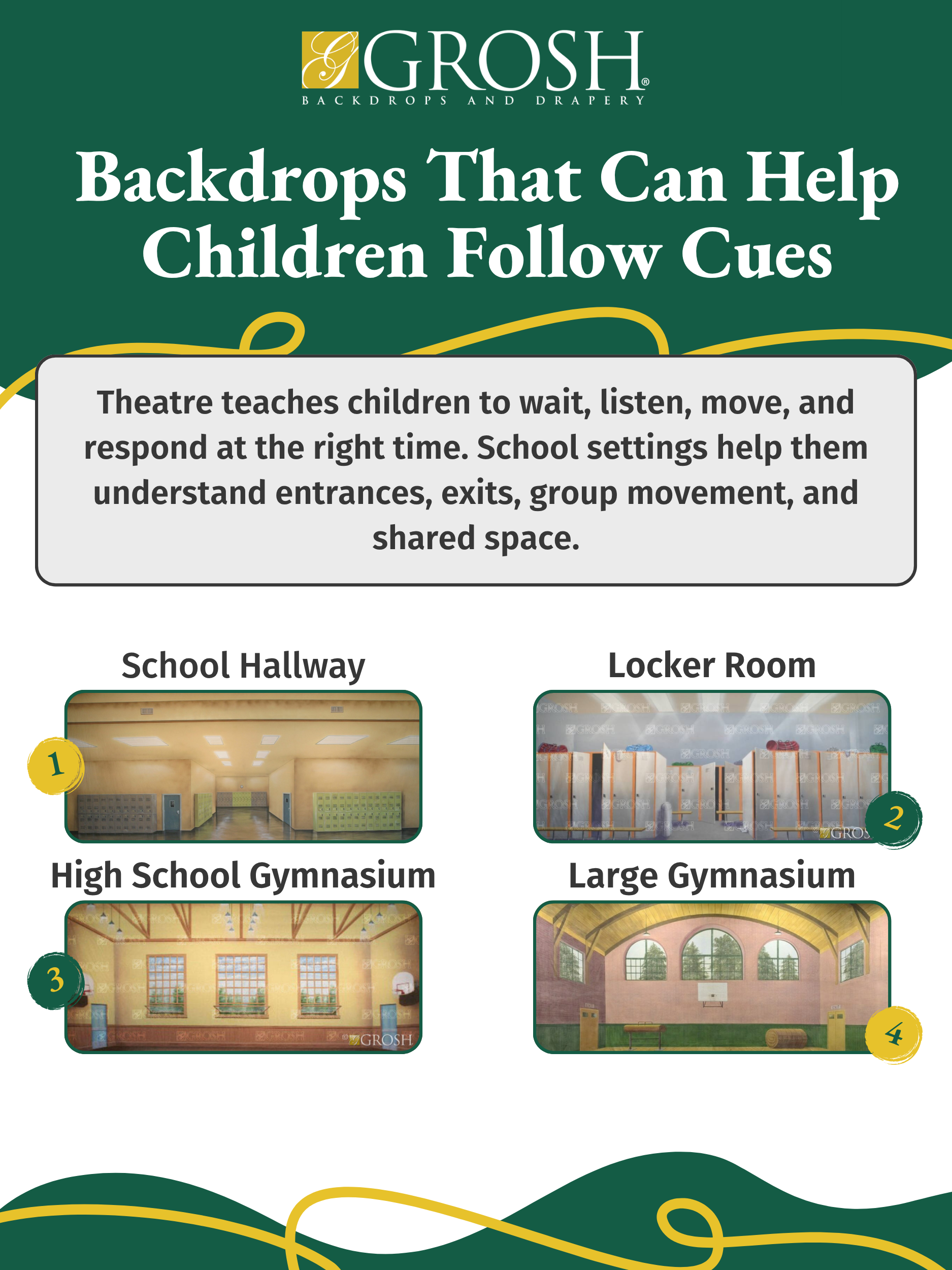
Backdrops can help with cues because they organize the stage. When the setting shows a hallway, a gym, or a locker room, children understand where entrances and exits might happen.
School Hallway
A School Hallway backdrop gives young performers a setting that naturally supports movement. Hallways mean walking, greeting, waiting, passing by, and entering rooms.

A hallway setting makes direction feel natural. Children can walk across the stage as if they move between classes, meet a friend, carry a message, or search for a teacher.
Locker Room
A Locker Room backdrop gives teachers a useful setting for plays about teams, friendship, nerves, competition, or school spirit.
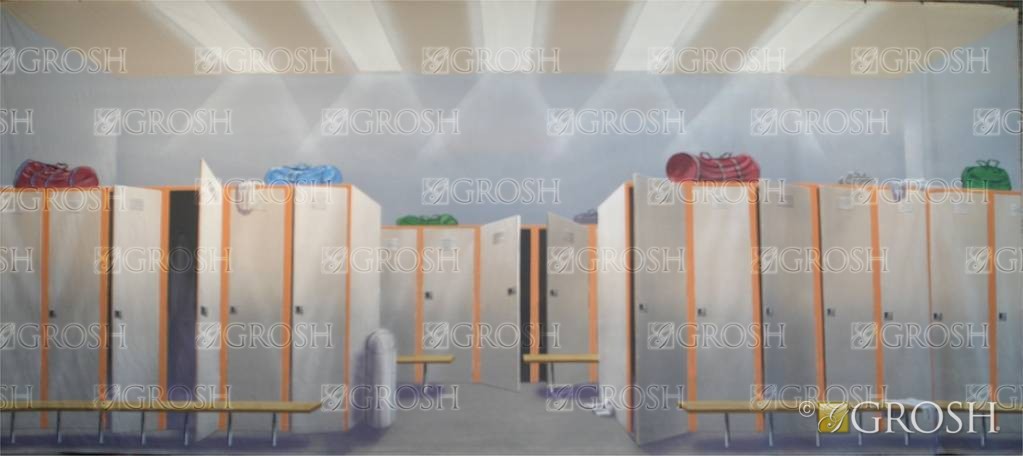
Group scenes help young performers learn spatial awareness. Children begin to understand that the stage belongs to everyone. They have to leave room for a friend, turn their bodies toward the audience, and wait for their cue instead of rushing into the next moment.
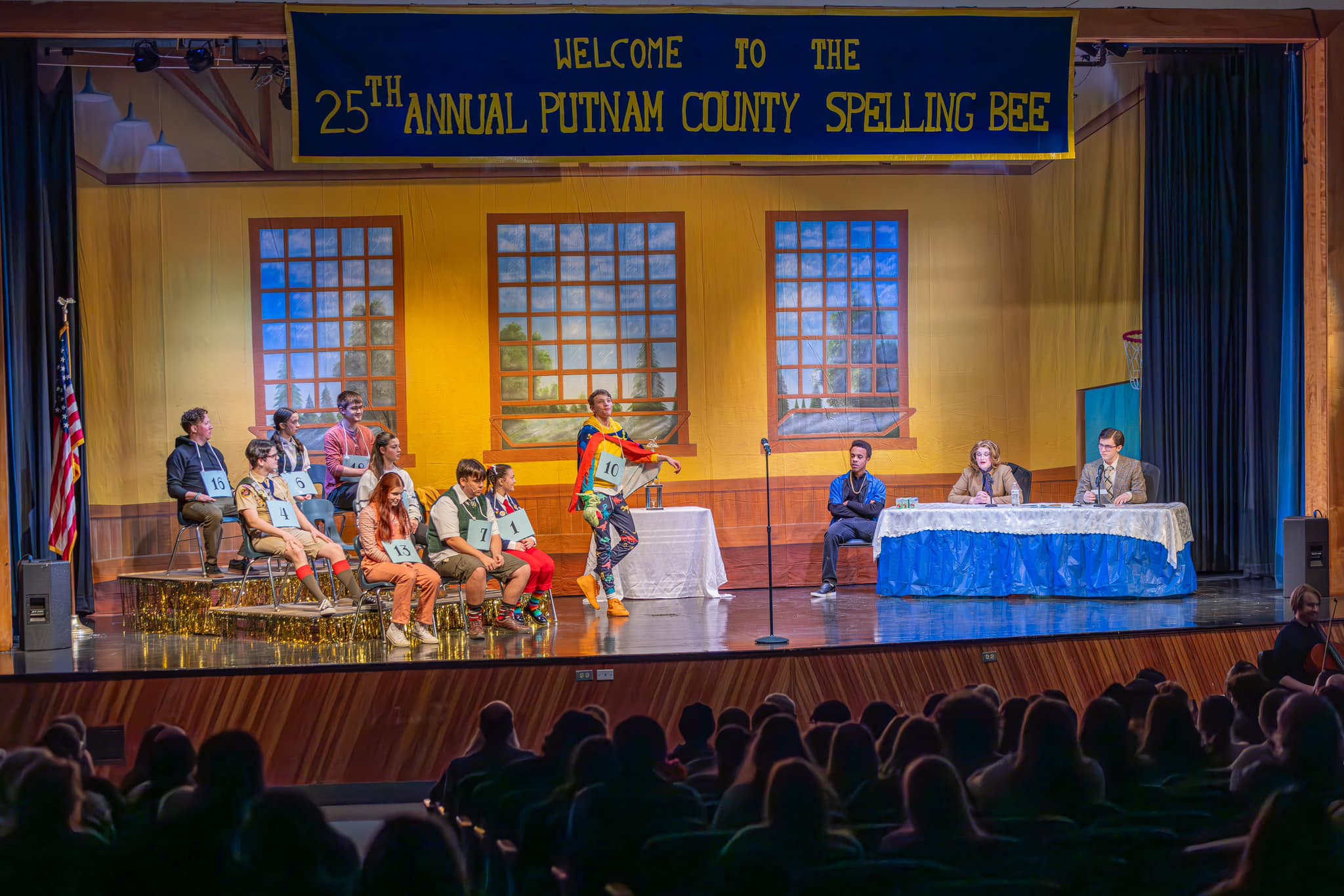
High School Gymnasium
A High School Gymnasium backdrop can help a school create a performance setting that feels open, active, and easy to read. Even younger children understand what a gym means.
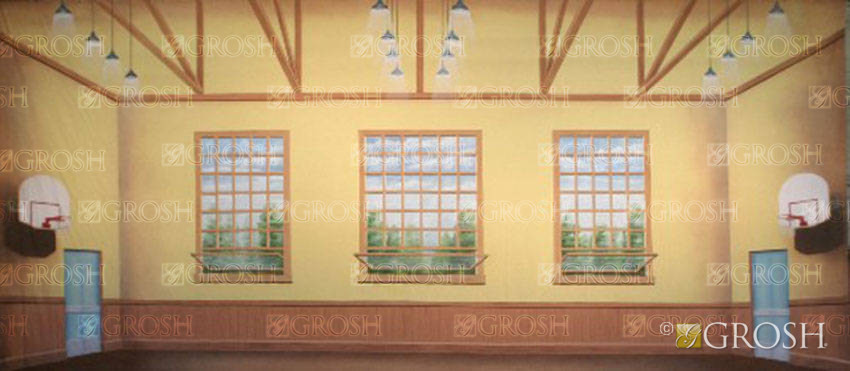
A gym setting also helps with listening. Children can learn to start a song together, freeze on a cue, cross the stage in lines, or wait while another group performs. The backdrop supports the sense that many children can share the same moment.
Large Gymnasium
A Large Gymnasium backdrop gives young performers an even broader school setting for movement-heavy scenes. It can support dance numbers, school assemblies, pretend-sports moments, or classroom productions that include many children onstage at once.

Movement helps children learn because it connects thought to the body. A young child who sings, steps, claps, turns, and speaks during a scene practices memory and focus in several ways at once.
Playing a Character Helps Children Build Empathy
Children often learn empathy through pretend play long before they can explain empathy in words. A child who plays a character can understand the role by asking simple yet powerful questions. What does this person feel? Why does this person feel happy, angry, proud, lonely, or brave?
Preschool and school theatre gives children a safe way to practice asking themselves those questions. And by asking them, they gradually put themselves into different roles that can help them understand complex emotions or reasons behind the way some people behave.
Playing different characters can also build children’s confidence or teach them how to talk about things they might usually be shy about. For example, a child might be shy when it comes to speaking about their fears, but on stage, they learn how to express it in a healthy way, or how to talk about it without shame.
Backdrops help encourage empathy by giving characters a social world. A palace, castle, gate, or royal room tells children that the character lives by certain rules. The setting shapes how the character might stand, speak, move, and react.
For early childhood theatre, storybook, and royal theatrical backdrops work especially well because they make character feelings big and readable.
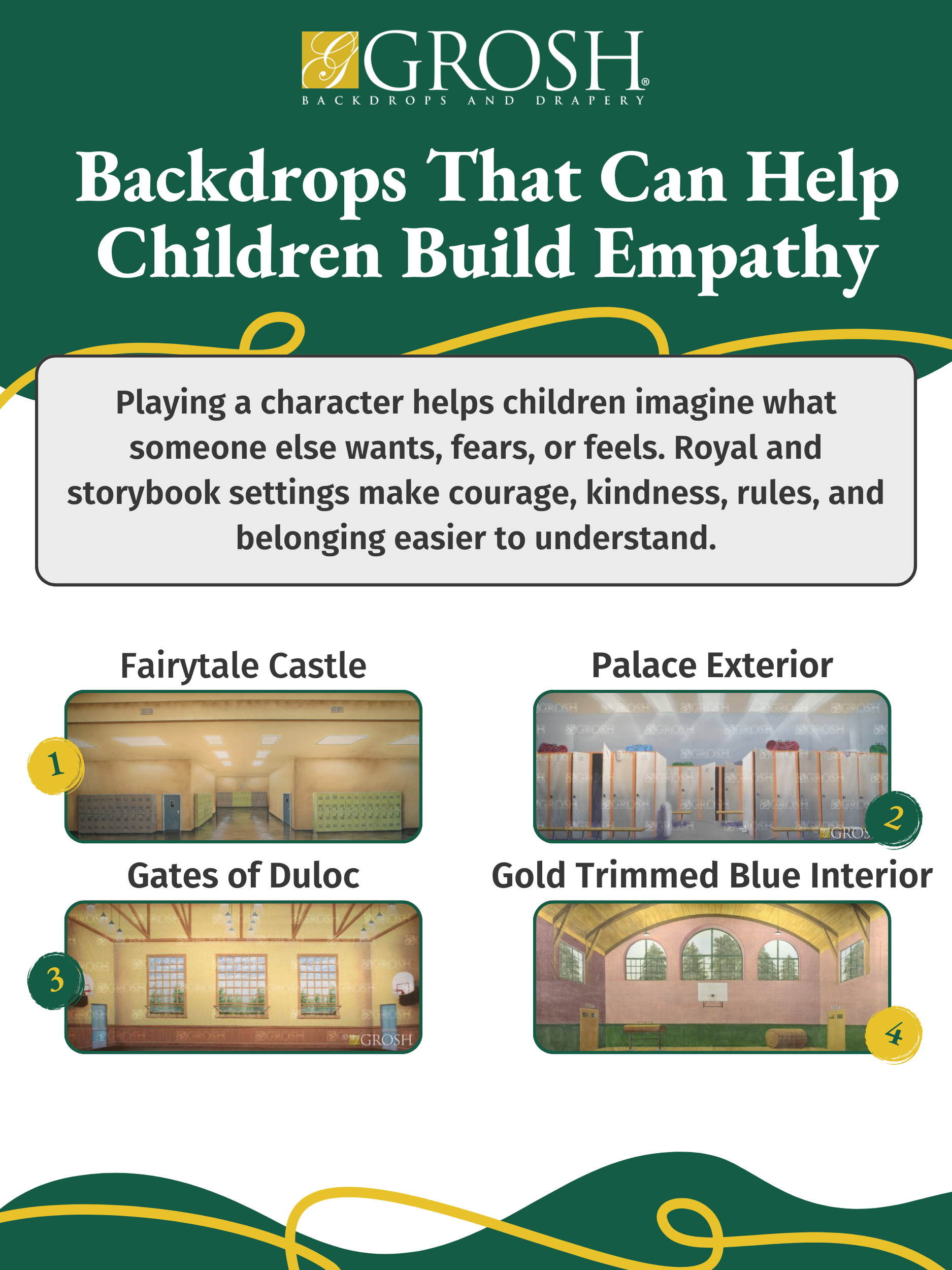
Fairytale Castle
A Fairytale Castle backdrop gives young children a classic visual language for adventure, courage, kindness, and transformation. Castles appear in many children’s stories, so the setting can quickly help performers understand the kind of world they have entered.
A child playing a prince, princess, guard, messenger, dragon helper, or lost visitor can use the castle setting to imagine what the character feels. Fairytale settings also help children process social roles.
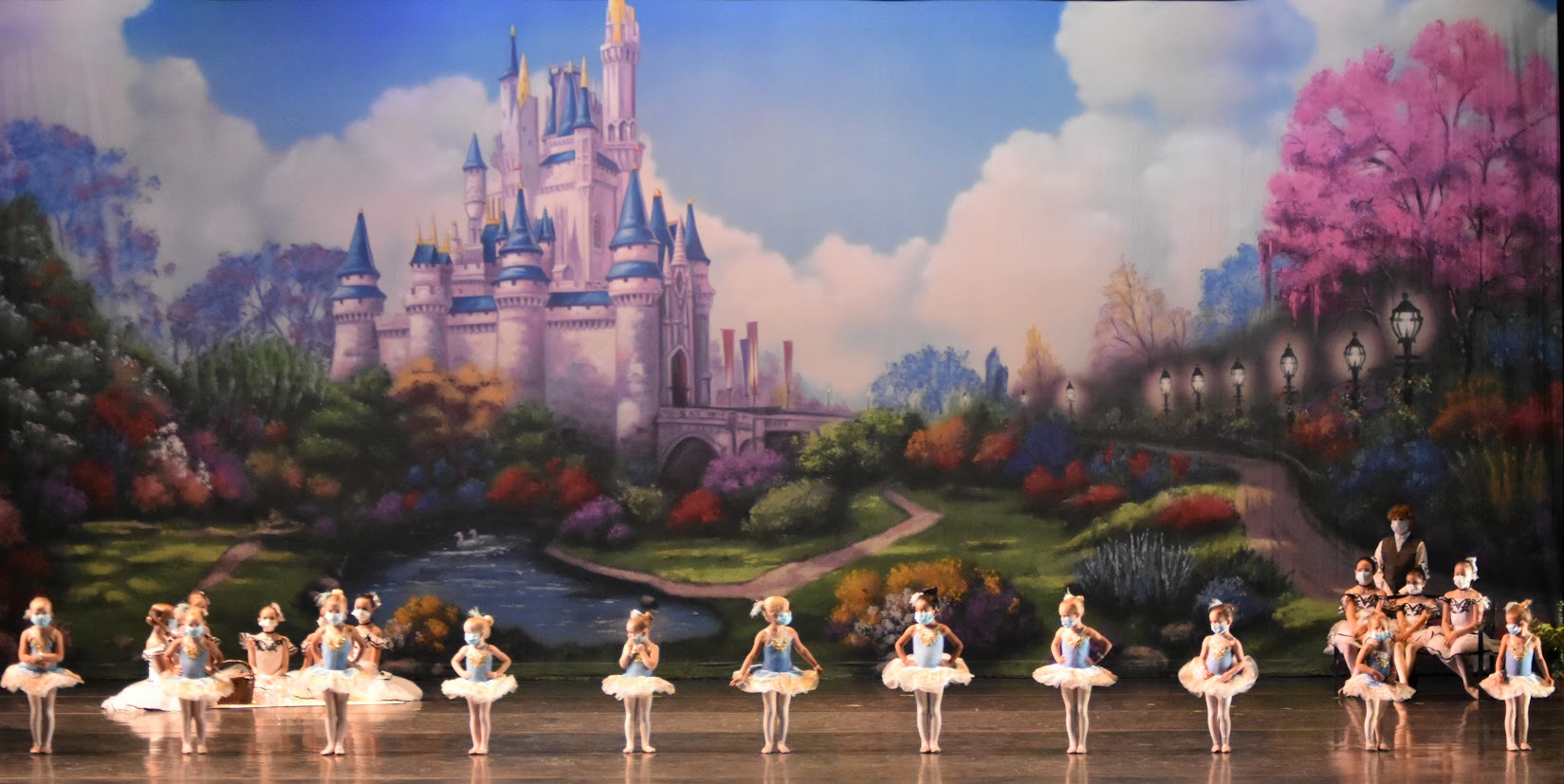
Palace Exterior
A Palace Exterior backdrop creates an elegant outdoor royal setting. It gives children a space where characters might arrive for a ball, ask for entry, meet someone important, or decide whether power should lead with kindness.
This backdrop also supports scenes where children practice polite speech, formal movement, and emotional restraint. They can bow, wait, greet, ask, and answer. Those behaviors build social awareness without turning the play into a lecture.
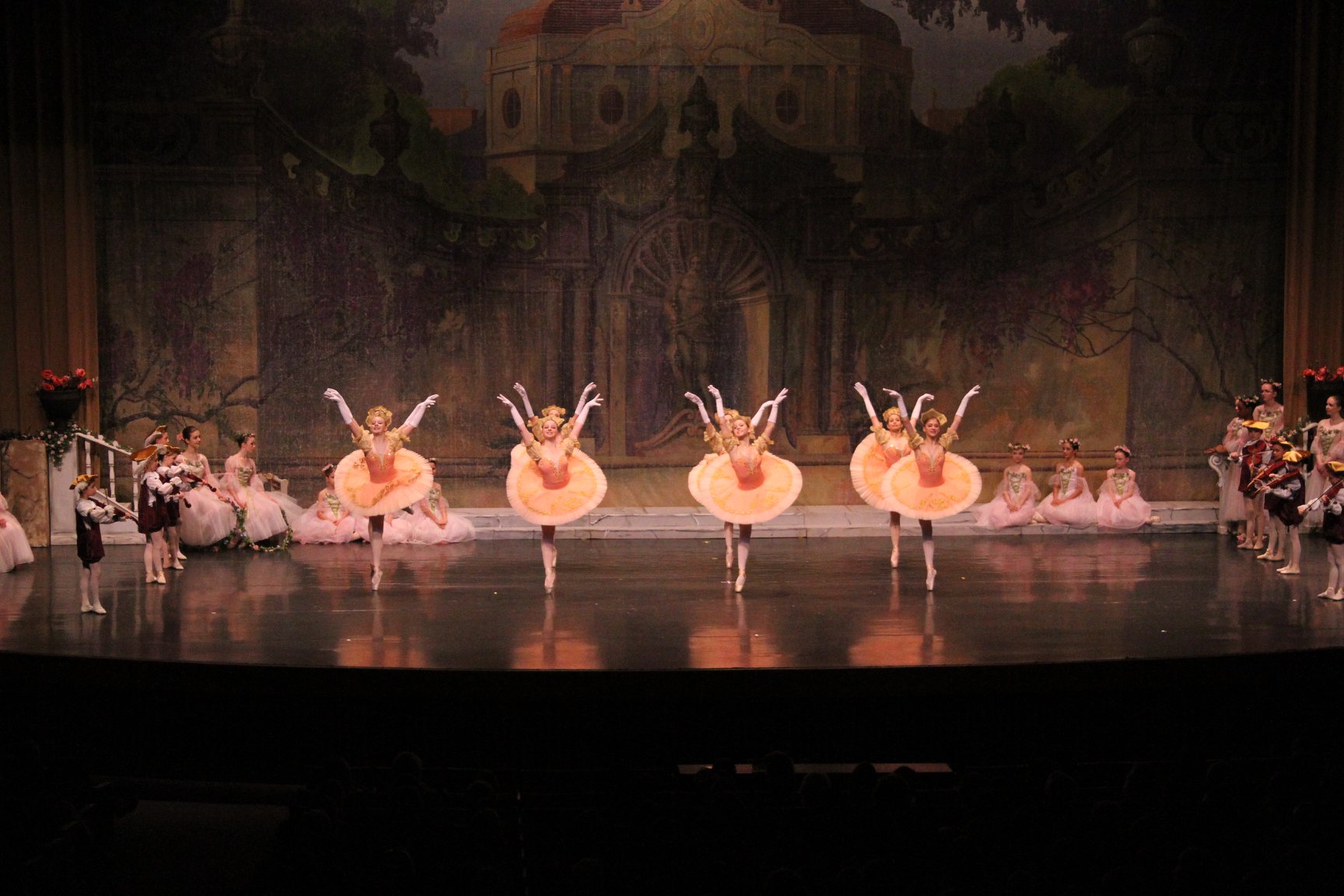
Gates of Duloc
The Gates of Duloc backdrop gives a production a strong entrance point. Large gates, walls, and a formal exterior create a setting where characters may feel excited, nervous, excluded, or curious.

That emotional range makes the backdrop useful for early childhood theatre. Children can play characters who want to enter a new place, follow a rule, challenge a rule, or help someone else feel welcome.

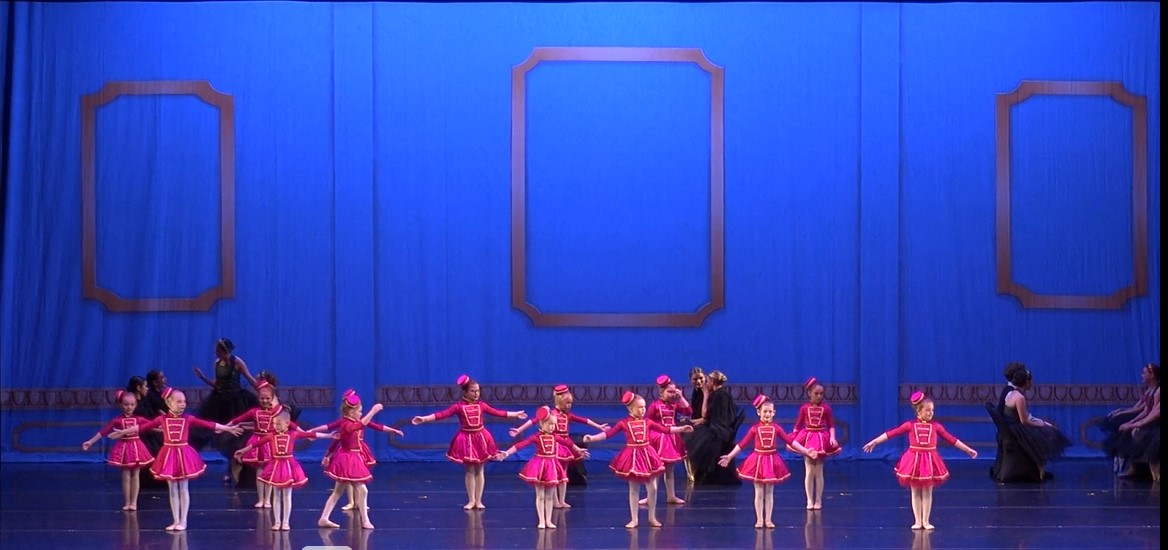
Gold Trimmed Blue Interior
A Gold Trimmed Blue Interior backdrop gives the school theatre a refined palace room with a calm, formal mood. Young children can use this setting to practice careful movement, polite speech, and emotional control.

Formal interiors help children feel how the setting affects behavior. A character may not run across a palace room the same way they would run through a park. The backdrop gently teaches children to adjust voice, posture, and timing.
Theatre Gives Children a Safe Way to Explore Big Feelings
Young children feel big emotions before they know what to do with them. Fear, jealousy, sadness, excitement, frustration, pride, and joy can rush through a child quickly. Theatre gives those feelings a safe container.
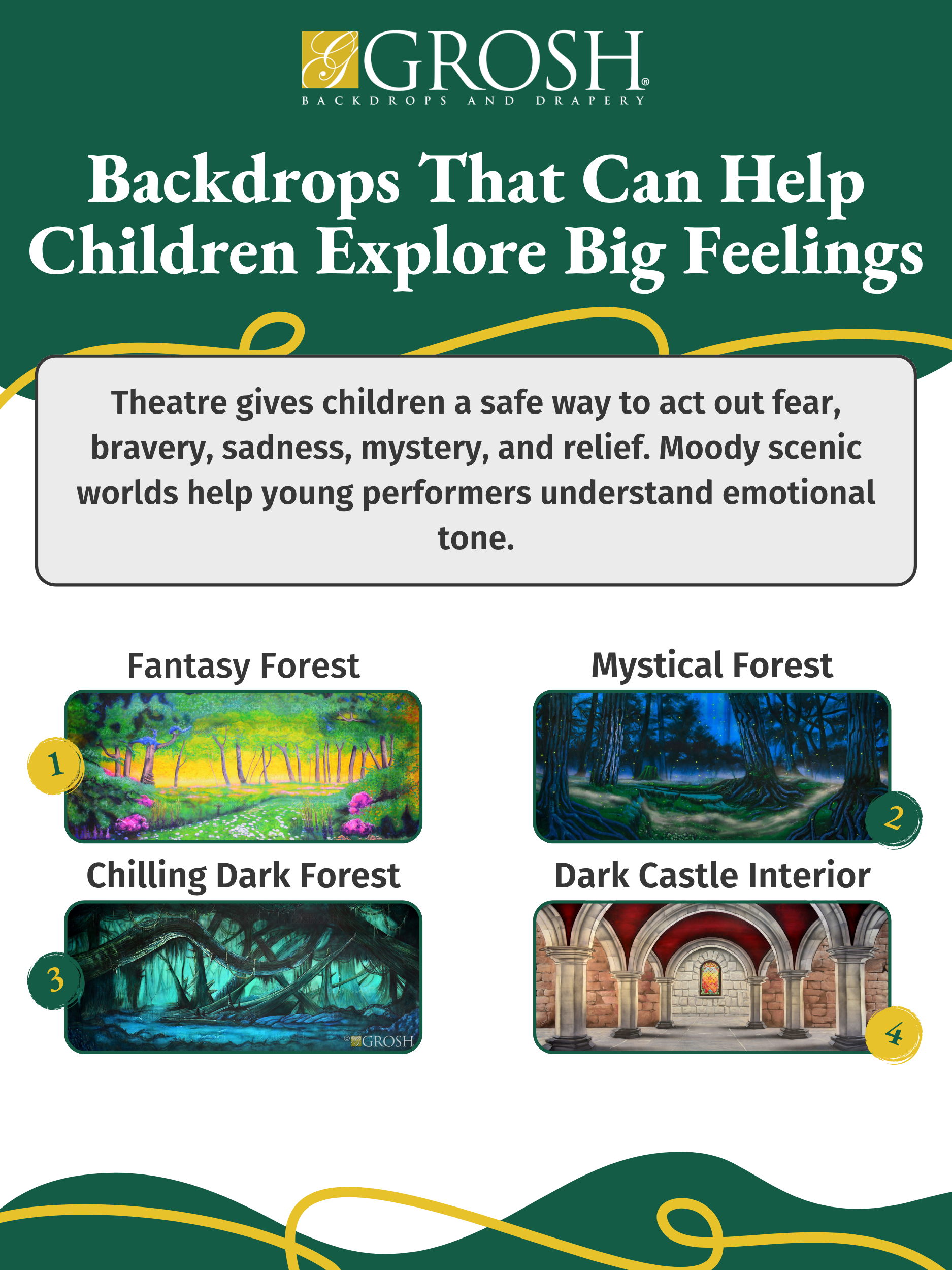
When a child pretends to walk through a dark forest with classmates, they practice courage in a safe, supervised space. When they pretend to cry, they learn that unpleasant feelings are a part of life too. Theatre lets children touch heavy feelings with structure around them.
The backdrop tells children what emotional temperature the scene has. It signals whether the moment calls for caution, wonder, bravery, or comfort.
Fantasy Forest
A Fantasy Forest backdrop gives young performers a magical, natural setting with color, trees, flowers, and a storybook sense of discovery. It can support scenes where characters enter the unknown, meet new friends, or search for a way home.

This backdrop can support plays about friendship, adventure, fairy tales, animals, woodland creatures, and children who learn to trust themselves. It gives young performers a visual reason to slow down, look around, whisper, call for help, or step forward with courage.
Mystical Forest
A Mystical Forest backdrop creates a deeper, more mysterious woodland mood. It can help teachers stage stories about secrets, nighttime journeys, magical helpers, or characters who have to pay attention to what they hear and see.
Mystery gives children a safe way to practice uncertainty. Many young children struggle when they do not know what comes next. A theatrical scene can turn that uncertainty into play.

Chilling Dark Forest
A Chilling Dark Forest backdrop can work for older early childhood groups or elementary performers who can handle a little stage tension. Dark trees, foggy effects, and a more intense atmosphere can support stories about getting lost, meeting a challenge, or finding bravery.
A director can lighten things up with humor, catchy music, friendly characters, or a clear moment where things get better. The main goal should always be to guide kids through big feelings instead of leaving them stuck in the scary stuff.

Dark Castle Interior
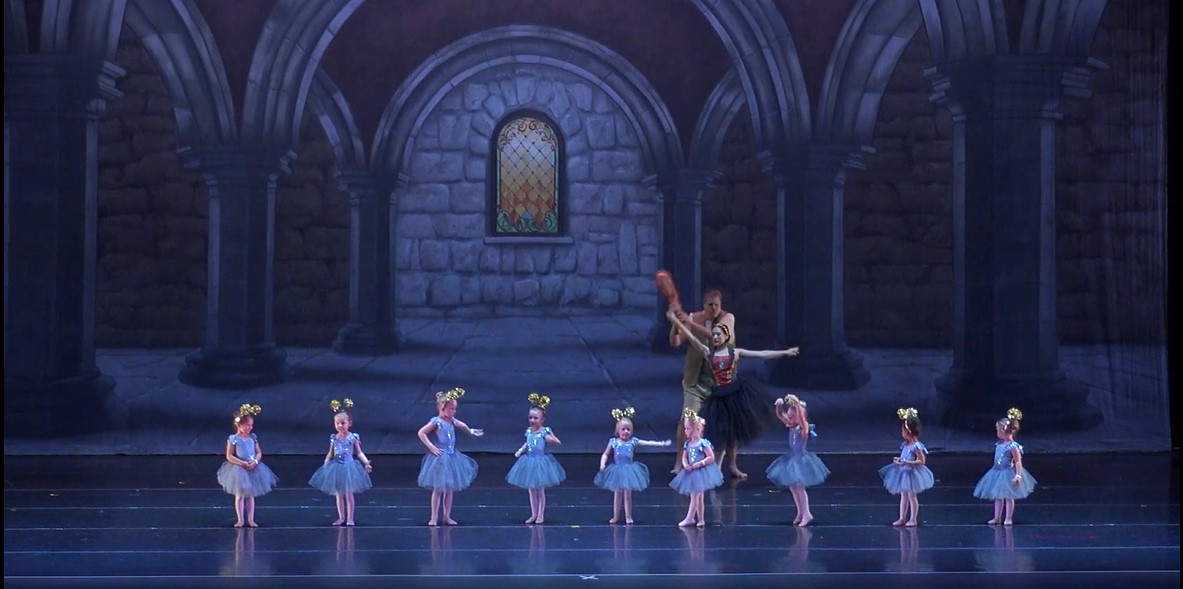
A Dark Castle Interior backdrop gives children a dramatic indoor setting for scenes that need tension, caution, or quiet strength. Stone walls, arches, and a shadowed medieval mood can help young performers understand that the story has entered a serious moment.

Children can practice lowering their voices, walking slowly, asking for help, or standing up for someone else. Those choices help them understand emotional tone. When a play moves from a bright toy shop to a dark castle room, children can feel the story change.
Imaginative Backdrops Help Children Step Into the Story
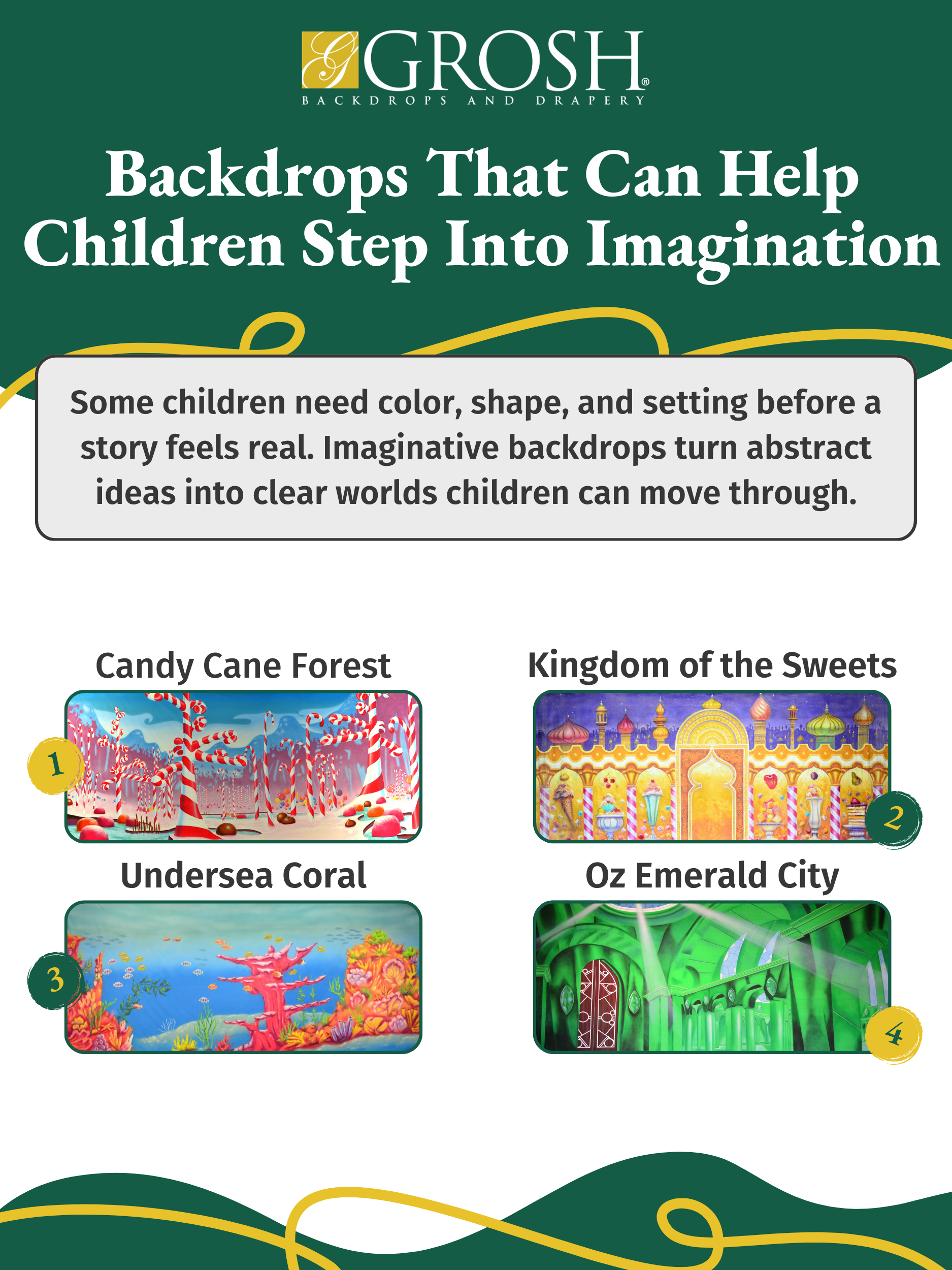
Some children can create a whole world from one chair and a sentence. Others need color, shape, and setting before the story begins to feel real. Early childhood theatre should make room and accommodate the needs of different children.
Backdrops especially help visual learners because they help them turn abstract ideas into clear images. A candy forest, an undersea world, or an emerald city gives children something specific to imagine. They can point to it, move through it, and respond to it.
Candy Cane Forest
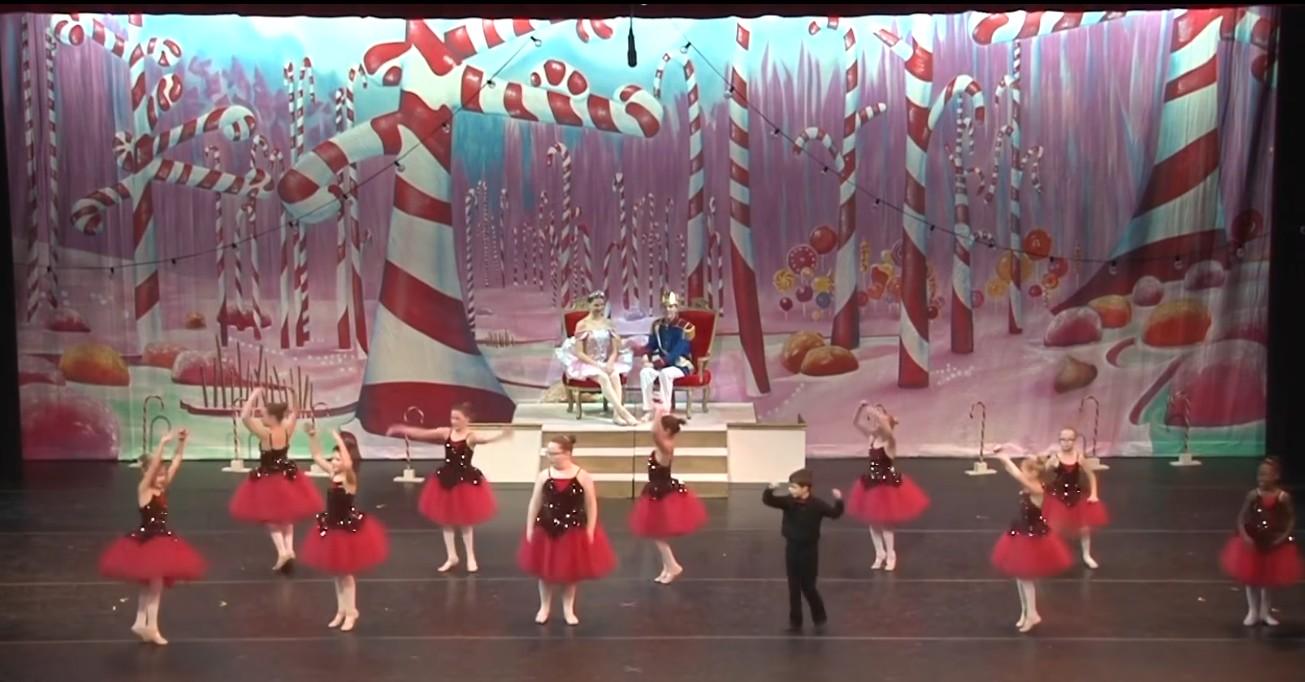
A Candy Cane Forest backdrop gives a production a playful holiday or fantasy setting filled with visual sweetness and strong color. Young children can read this world quickly. They know it does not belong in everyday life, and that makes pretend play easier.

Candy-themed scenery works well for early childhood performances because it invites big reactions. Children can gasp, laugh, point, march, dance, or tiptoe through a world that already feels magical. The setting permits them to be expressive.
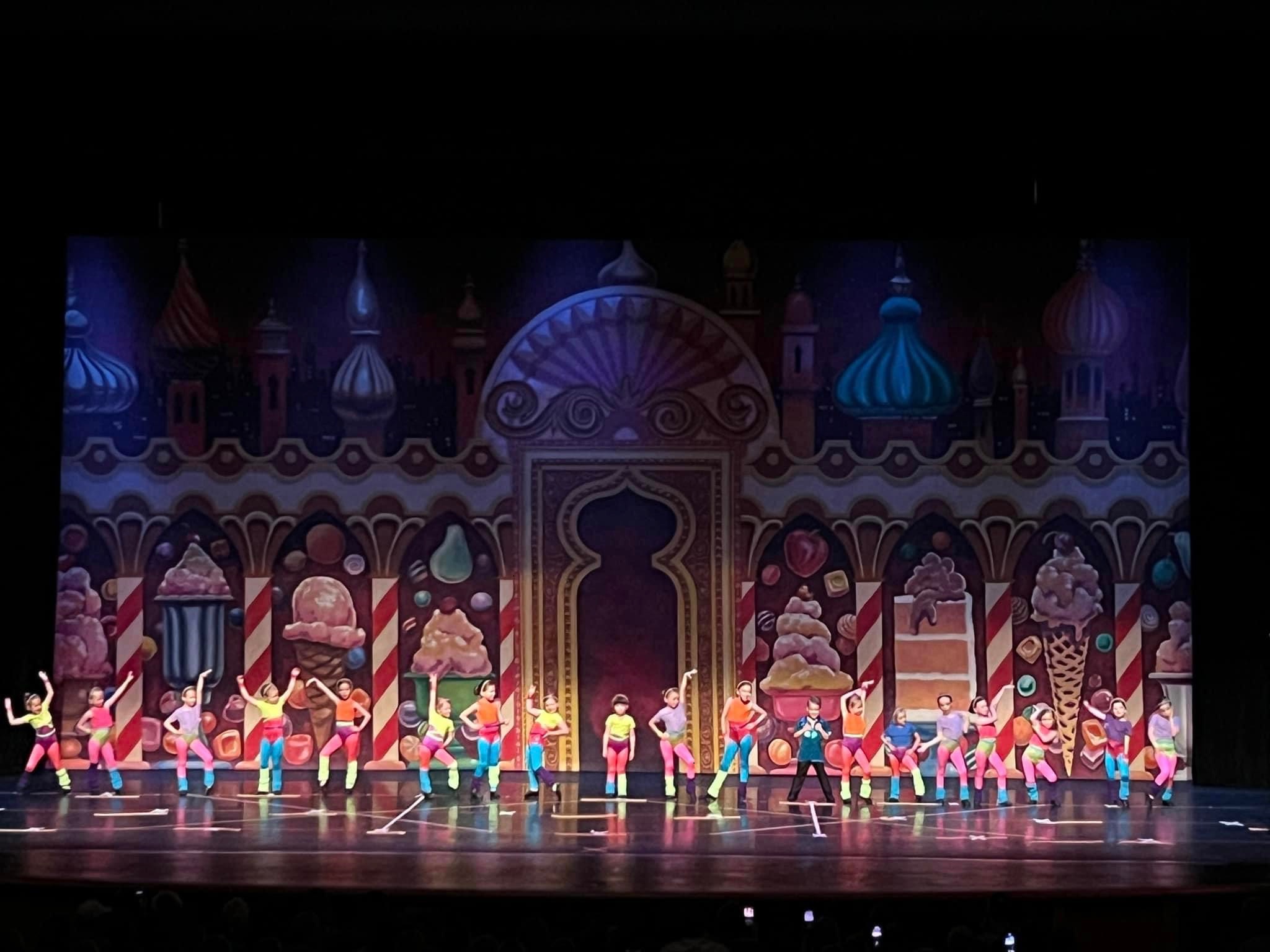
Kingdom of the Sweets
The Kingdom of the Sweets backdrop style suits school productions that need a joyful, magical kingdom. It can support dance numbers, holiday plays, Nutcracker-inspired scenes, and early childhood performances where children enter a world of treats, color, and celebration.

A sweets-themed backdrop also supports group performance. Children can enter as candies, bakers, visitors, dancers, toys, or royal helpers. Each role can feel simple and easy to read, which matters for younger casts.
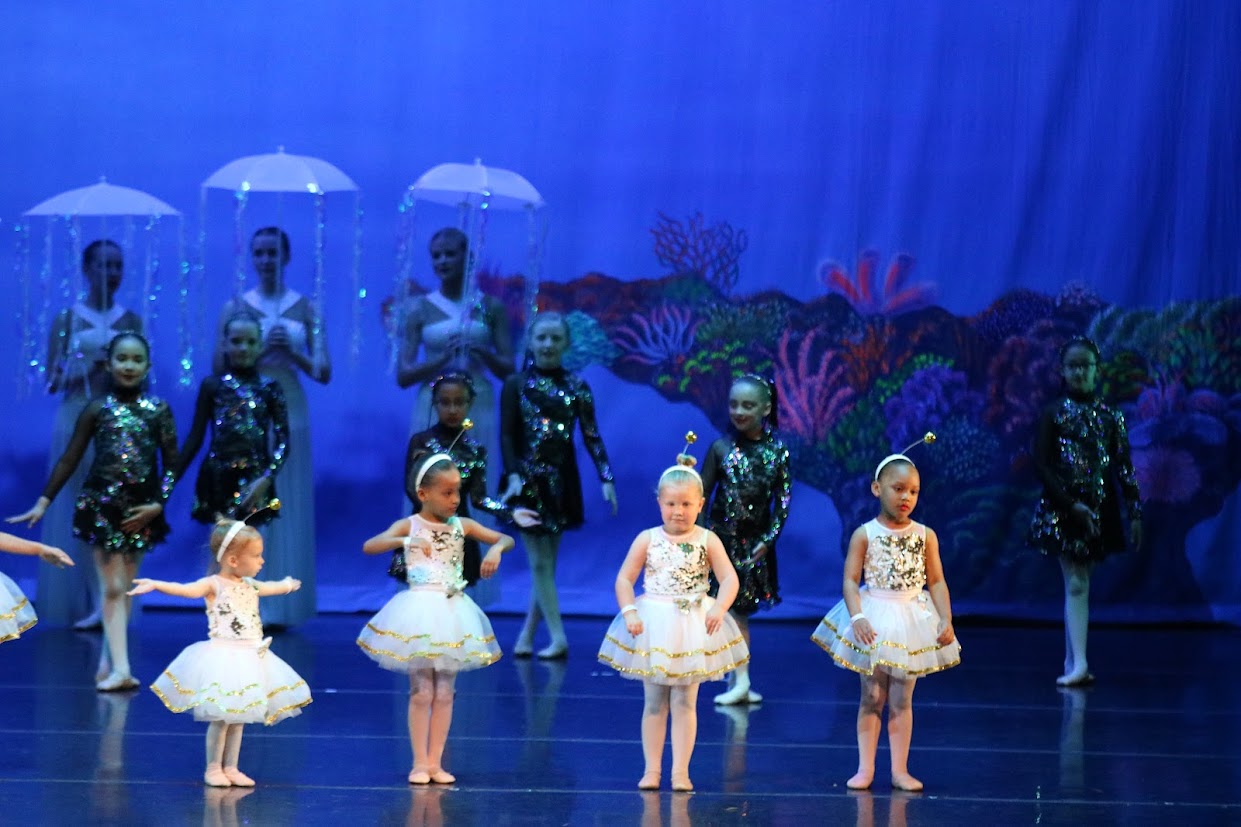
Undersea Coral
An Undersea Coral backdrop can take children far away from familiar classrooms, bedrooms, and playgrounds. Coral, ocean color, and underwater imagery help young performers imagine a world where bodies move differently, and characters communicate in new ways.

This setting can also help children practice empathy with nonhuman characters. A child who plays a small fish, a sea creature, or a lost visitor has to imagine a different kind of life.
Oz Emerald City
An Oz Emerald City Interior backdrop gives the school theatre a grand fantasy setting with a sense of arrival. It works well for stories where children finally reach a magical place, meet someone important, or discover that courage and kindness matter more than appearances.
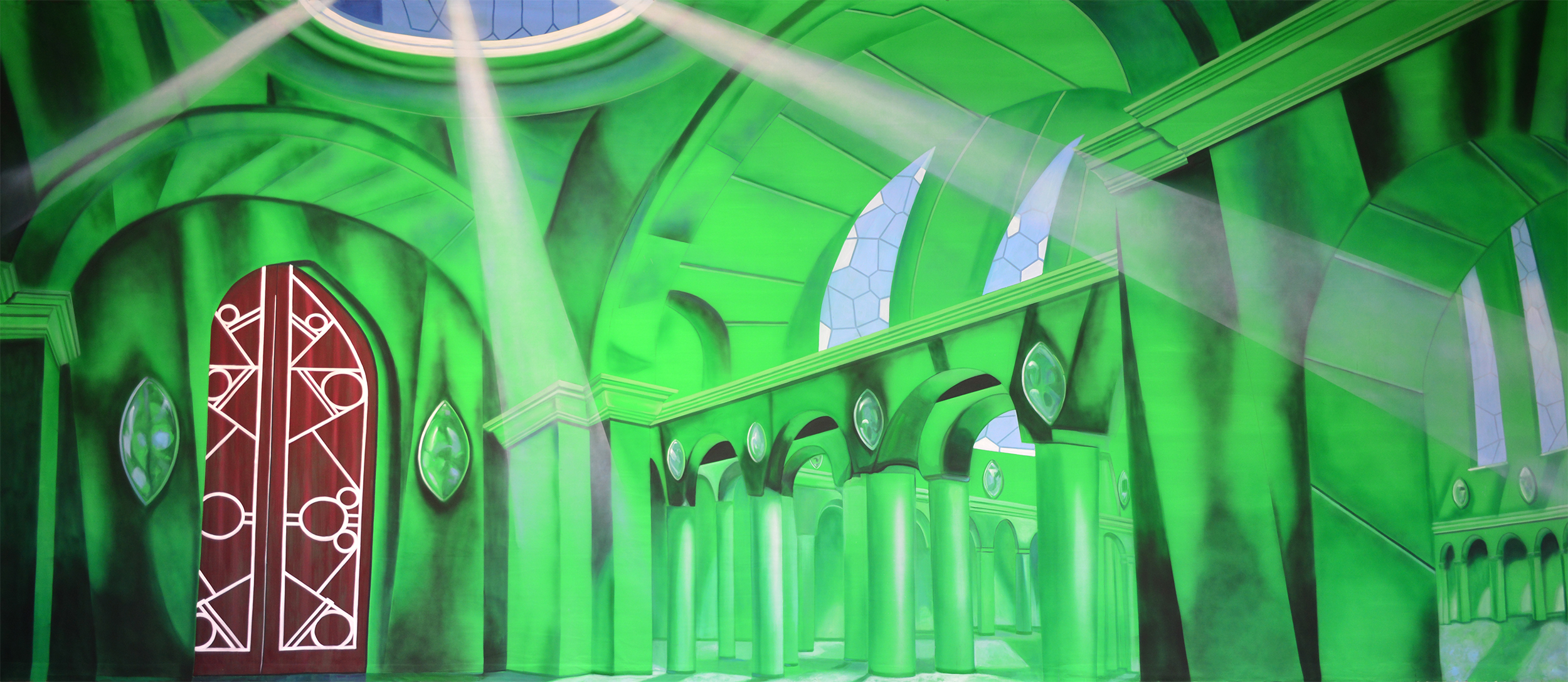
The Emerald City style also gives children a chance to practice awe. Awe can matter in children’s theatre because it teaches them to slow down and notice. A child can look up, pause, whisper, or smile before speaking.

Group Performance Teaches Cooperation and Confidence
Early childhood theatre gives children a shared goal. Even when they have individual lines, they rely on classmates, teachers, music, scenery, costumes, and the audience. That shared structure teaches cooperation.
Children learn to wait while someone else speaks. They learn to move together, sing together, and recover when something does not go exactly as planned. Those lessons matter because young children often need practice seeing themselves as part of a group.
Confidence grows from preparation. A child rehearses a line, forgets it, tries again, remembers it, and eventually says it onstage. That process teaches them that they can improve through practice.
Backdrops help cooperation by giving the group a shared world. A park, town square, or small town street gives children a place where many characters can gather. The setting supports scenes with neighbors, friends, families, classmates, or community helpers.
For schools, these community-based backdrops can help early childhood theatre feel warm, accessible, and connected to real life.
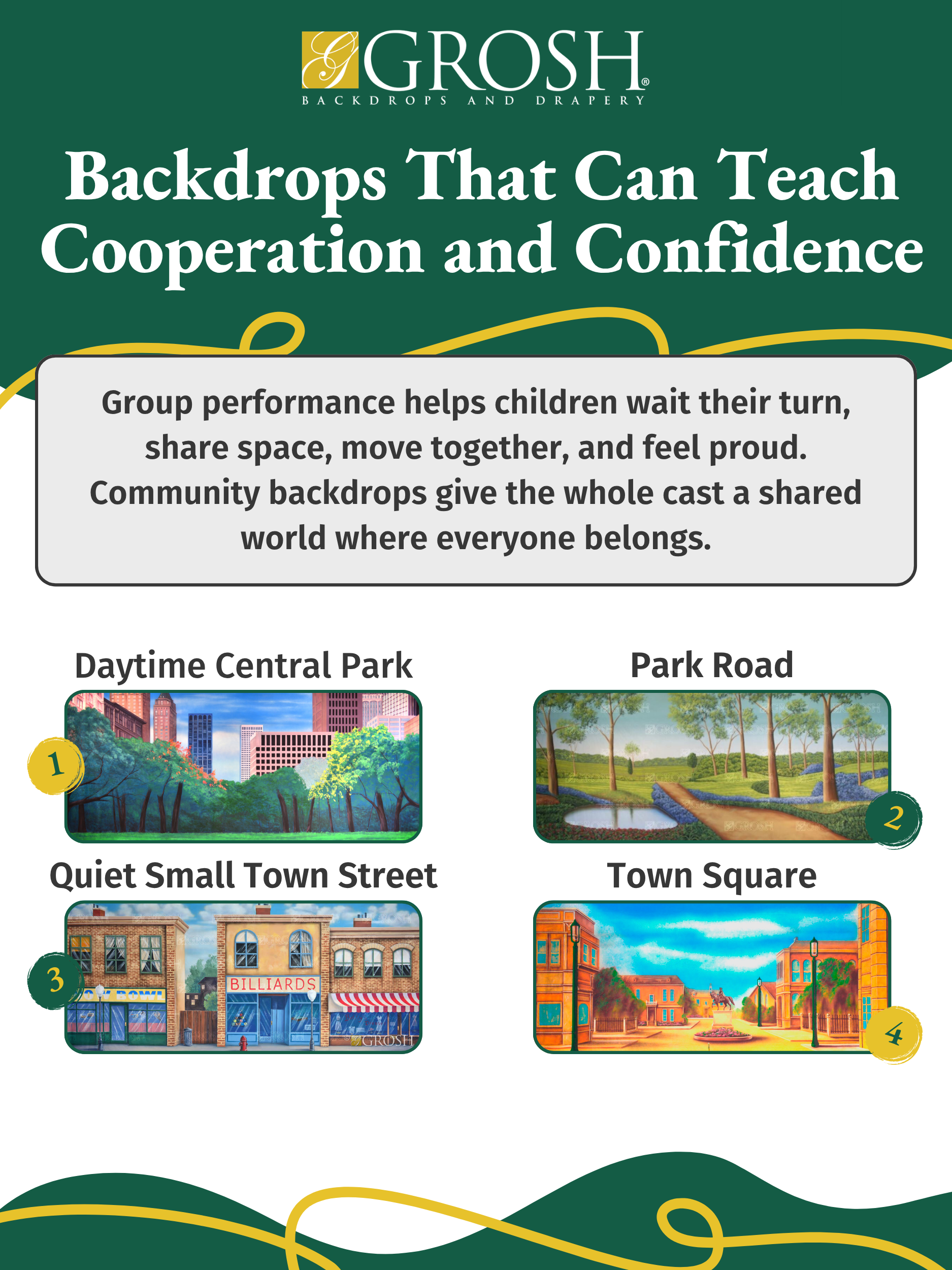
Daytime Central Park
A Daytime Central Park backdrop gives young performers an open outdoor setting where many kinds of characters can meet. Parks naturally support group scenes because children understand them as shared spaces.

A park setting can work for plays about friendship, kindness, seasons, field trips, animals, family outings, or community helpers. Children can enter from different sides, gather in small groups, sing together, or move through a simple outdoor story.
Park Road
A Park Road backdrop gives early childhood theatre a simple path. That may sound small, but a path can help young children understand one of the most basic story ideas. A character goes somewhere.

This setting can also support cooperation. Children can travel in pairs or groups, stop to help a friend, follow a leader, or decide together which way to go. These actions teach children to notice others and share decisions.
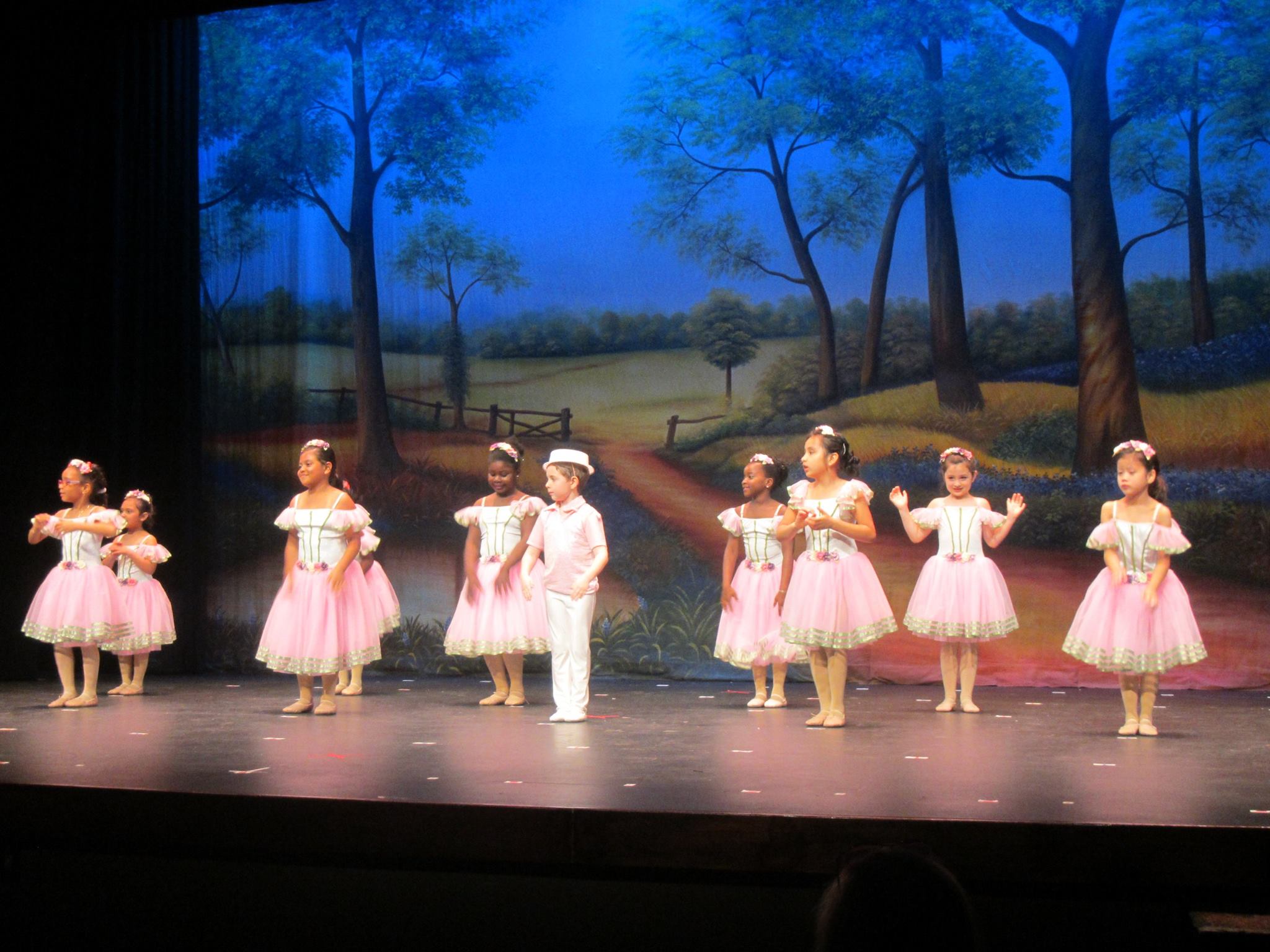
Quiet Small Town
A Quiet Small Town Street backdrop gives schools a community setting for stories about neighbors, families, shops, school events, or everyday kindness. Young children often connect strongly with real-life settings because they can recognize the social rules quickly.
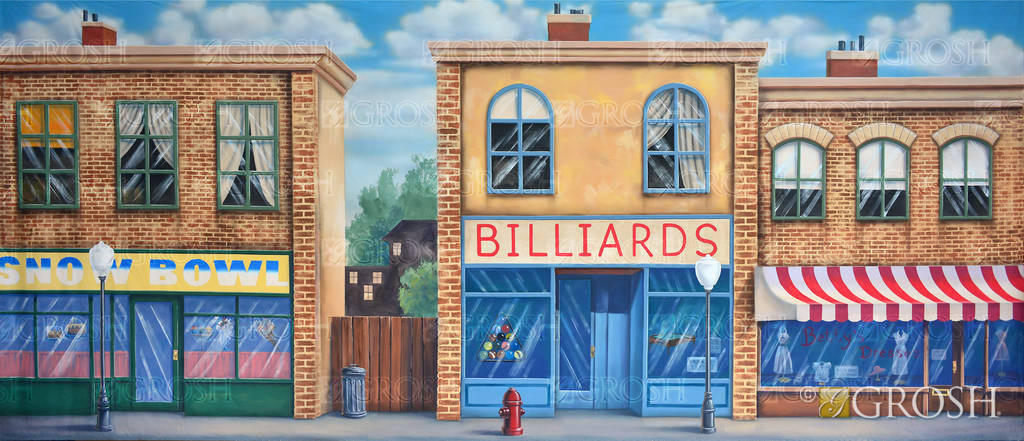
A small town street can support scenes where children greet one another, ask for help, deliver a message, find a lost object, or prepare for a local celebration. These simple story actions help children practice communication and cooperation.
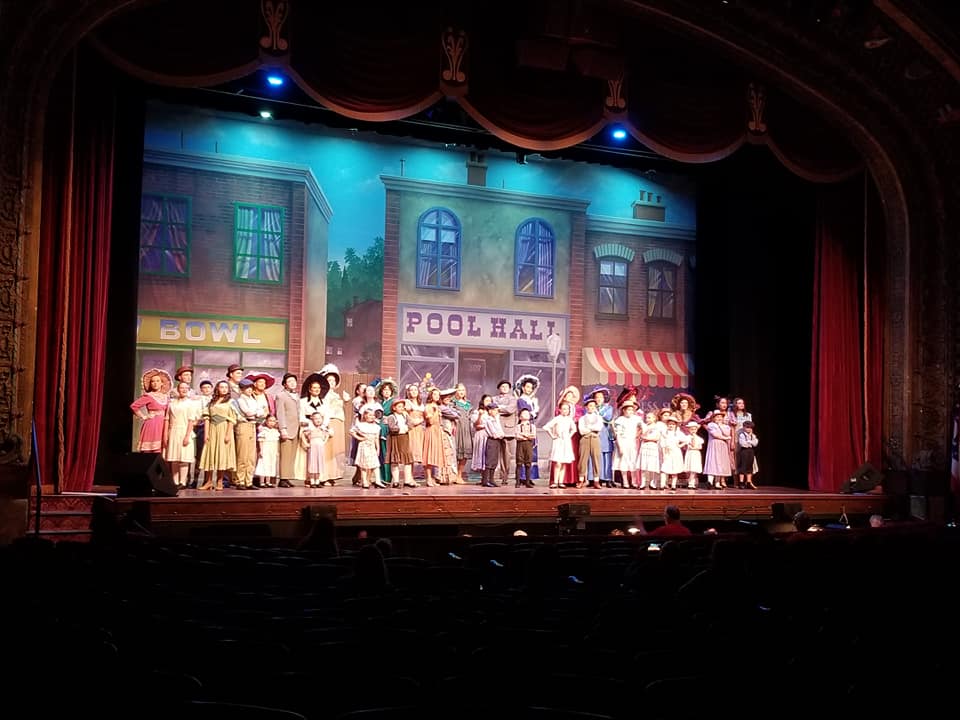
Town Square
A Town Square backdrop gives a production a natural gathering place. That makes it useful for early childhood shows with larger casts, final songs, group dances, announcements, festivals, or story endings where many characters come together.

For young children, a town square can also help with confidence. A final group scene feels less scary when the child stands with classmates inside a clear setting.
Choosing Early Childhood Theatre Backdrops With Learning in Mind
When choosing theatrical backdrops, teachers and directors should pay attention to the age of the performers, the size of the cast, and the emotional tone of the story.
Children in preschool and first or second grade often benefit from scenery with clear shapes and settings that are easy to read and recognize, so using something simpler, like a forest, a castle, a classroom, or a school exterior, is usually the safe choice.
But because children can learn something from theatrical backdrops as well, you can enrich the visual background with one or two pieces that depict something not every child has seen or heard about.
Seeing something new, like a strange machine, faraway lands, or planets, encourages curiosity in children and allows you to tell them an interesting educational story they will probably remember, even years down the line.
If you have questions about backdrop rentals, sizing, availability, or you need help choosing the right theatrical backdrop for your next production, do not hesitate to reach out. We will be happy to help!



 8050 San Fernando Rd.
Sun Valley CA 91352
Call Us Toll Free
8050 San Fernando Rd.
Sun Valley CA 91352
Call Us Toll Free